Friends,
You already know that June is LGBTQIA+ Pride Month, and June 19th is Juneteenth, but did you know that June is also Neurodiversity Pride Month (with June 18th being Autism Pride Day), and July will be Disability Pride Month? While the proximity of these celebrations on the calendar is coincidental — each are tied to different events/birthdays — , I view it as beautiful serendipity.
Language is ever-evolving, and a lot has changed in the neurodivergent and disability communities over the past few decades. Thus, my friend Rev. Angela Wells suggested that I, a disabled AuDHD queer woman, write an Autism Pride tutorial for her congregation’s newsletter with great vocabulary words I’ve learned, key distinctions, and some words that should be tossed out. For brevity, I’m only including a sample of words that directly impact the autism community in this post.
Awareness vs Pride: For the neurodiversity and disability communities, there is a big difference between having an awareness event versus a pride event. Pride events center and celebrate the people behind the label. They are about rejecting bigoted stereotypes that others associate with us and focusing on what we love about ourselves. Awareness events are about educating the population outside of our community. They tend to focus on our struggles and perceived deficits, and, sadly, often do not center our voices. Thus, awareness events can unintentionally be highly offensive. The debates around awareness vs pride are complicated; we must differentiate between when medical innovations are desired and when the “cure” we seek is transforming the beliefs and social systems that harm us. Note that most autistic persons have related medical issues, so an individual can proudly see their neurodivergence as integral to who they are (e.g., “I am autistic”) and wish doctors could solve the problems that come with it (e.g., “I have conditions that disable me”).
Neurodivergent vs Neurotypical: A neurodivergent person is anyone whose brain wiring — by birth or later event — diverges from what society views as normal. A neurotypical is someone who is not neurodivergent by their society’s standards, and thus does not experience struggles or marginalization due to their neurotype.
Neurodiversity and NeuroTribes: These terms frame neurological differences as being a natural part of a diverse human population. They stand in contrast to models that treat variations of brain wiring as aberrations to be eliminated. Usage example: Christ UMC is a neurodiverse congregation that advocates for neurodiversity in leadership structures. Neurodivergent persons from various neurotribes are represented on its committees, and together they consider the needs, preferences, and gifts of all the community when creating worship, study, service, and fellowship opportunities.
The Neuroarchy: The social systems/structures that privilege neurotypical brains while marginalizing divergent ones.
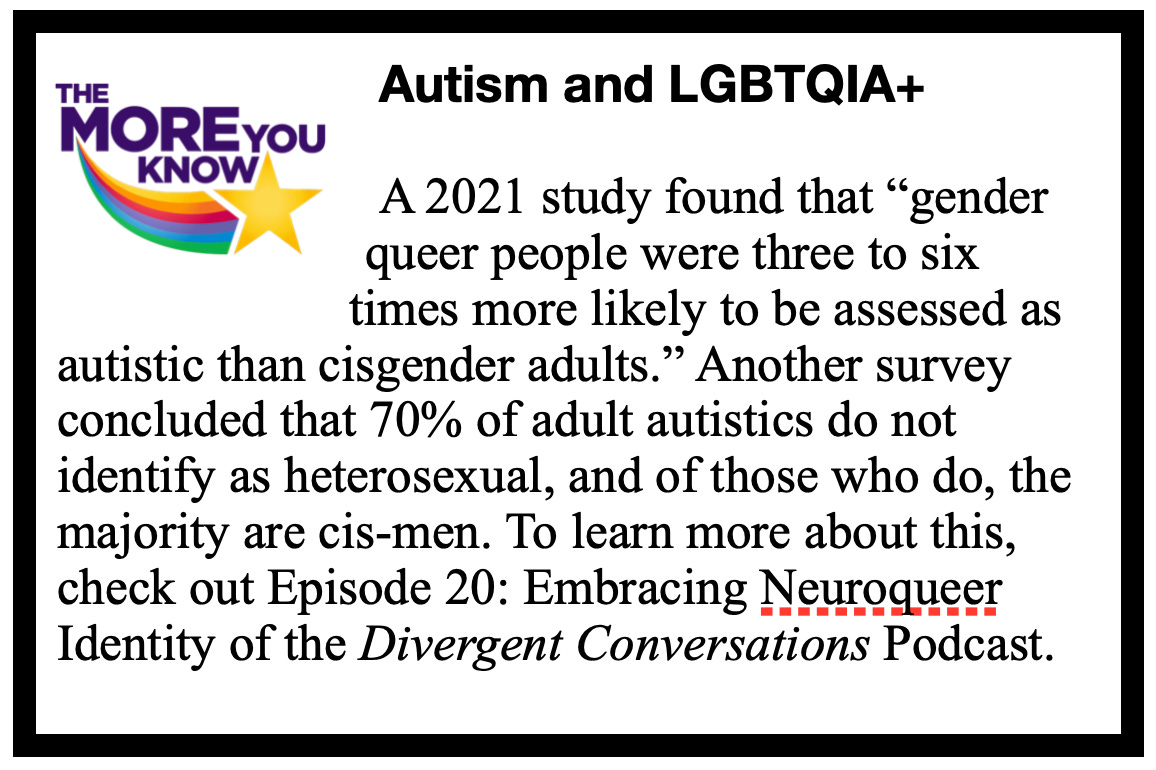
Neuroqueer: This beautiful word sits at the intersection of neurodiversity and queerness and defies one-sentence definitions. Please read Nick Walker’s 800 word unpacking of it: https://neuroqueer.com/neuroqueer-an-introduction/
Monotrope/Monotropism: These are my other my favorite new words. A person with a monotropic mind tends to focus on one interesting thing at a time. In contrast to neurotypicals with polytropic minds, monotropes are extremely good at sustaining intense focus (hyper-focus) for remarkable periods of time, which has its evolutionary advantages. However, it can also create “tunnel vision,” resulting in a failure to notice other important things, including social cues. Check out monotropism.org to learn more.
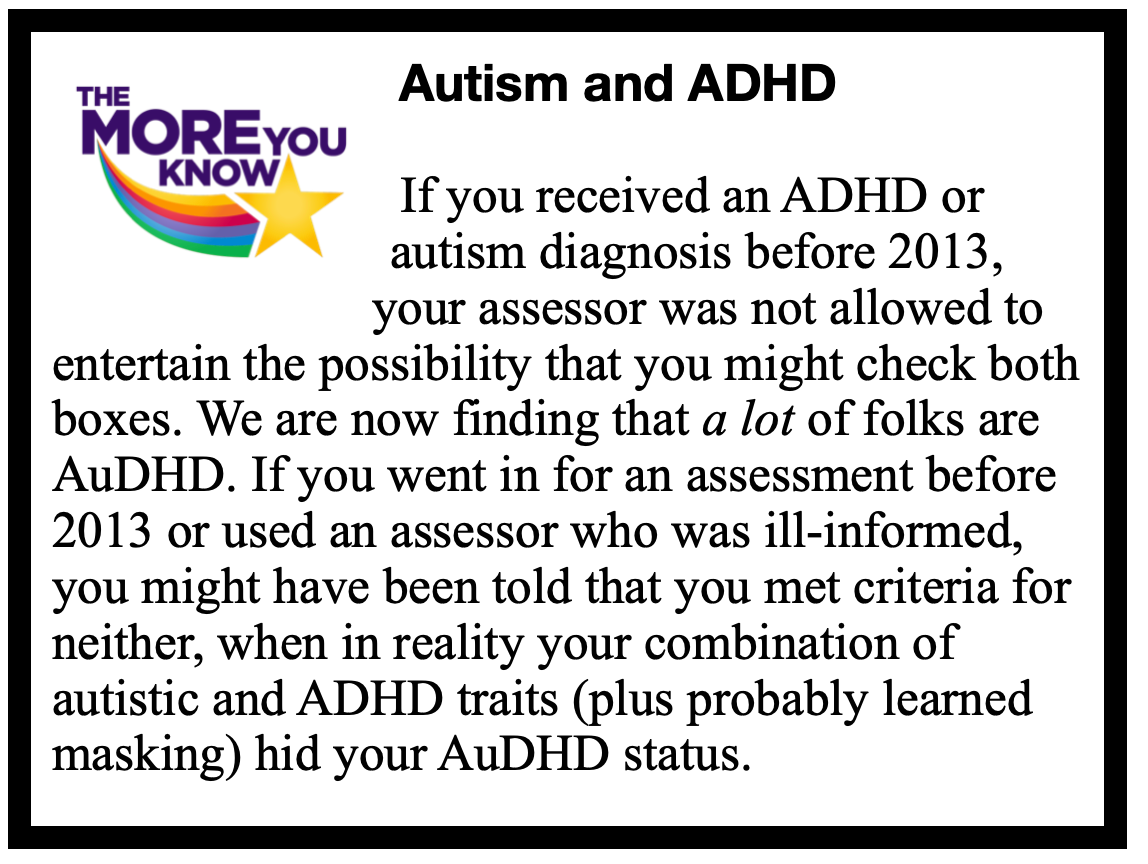
Masking: Hiding or suppressing one’s neurodivergent traits in order to pass as neurotypical and thus avoid rejection/marginalization. Folks who are skilled at masking often don’t get the supports they need and end up struggling with anxiety, depression, and burnout, especially in adulthood. When they do seek mental health help, they are often misdiagnosed.
Asperger’s and High Functioning/Low Functioning Autism: Toss “Asperger’s” from your vocabulary unless it is what you chose for yourself. You can google why it is problematic. If someone received that assessment before the label was removed from the diagnostic books, they are autistic with low support needs. We also no longer speak about people based on the degree to which their “functioning” is useful to the capitalist economy. When necessary, we differentiate based on a person’s support needs, noting that support needs can fluctuate over time. A person who was once labeled as “low functioning” or “profoundly autistic” can be described as having high support needs, or Level 3 autism.
The Puzzle Piece vs the Autism Pride Logo: It is important to know that there is a major divide in the autism advocacy world: those who frame autism as a tragedy, something that deprives parents of their “real” children and thus must be treated and cured, and those who view it as a difference that deserves support and affirmation. Which autism symbol you use marks you as either potentially safe or definitely unsafe to autistic youth and adults. The “therapy” pushed by the puzzle piece group, for example, was developed by the same man who created gay conversion “therapy.” Thus, my household is a rainbow infinity loop family.
Want to Know More? Here’s a Reading List To Start Your Journey!
Neurodiversity Affirming Training Handbook
Unmasking Autism: Discovering the New Faces of Neurodiversity
Neuroqueer Heresies
Autistic and Black: Our Experiences of Growth, Progress and Empowerment
Divergence: Toward a Neurodivergent Latinx Liberative Social Ethic
The Autistic’s Guide to Self-Discovery: Flourishing as a Neurodivergent Adult
NeuroTribes: The Legacy of Autism and the Future of Neurodiversity
With All Your Mind: Autism and the Church
The ADHD Field Guide for Adults
The Sacred Spark: Exploring the Hidden Gifts of ADHD in Spiritual Leadership
Blessed Minds: Breaking the Silence about Neurodiversity
“Working as ‘Rebellious Disruptors’: Neuroqueering and Cripping Academic Spaces Within the Sociology of Religion”
“Prophetic Prospects for Awkward Neurodivergent Liberation Theology”
The Brain Forest (illustrated book for reading to children)
More of a Podcast Person?
Check out the Divergent Conversations and Autistic Liberation Theology podcasts